Connect SharePoint
Knowledge
The SharePoint connector indexes documents, lists and site pages from the Microsoft 365 sites you name, and it is the one connector that carries the source's own permissions into Katonic on every sync. This page covers what is specific to SharePoint; the steps every connector shares are in Add a knowledge source.
Who can use it: the Builder role, or a Member holding the Knowledge Admin grant, in a tenant licensed for knowledge. One-click sign-in also needs an administrator to have stored a SharePoint OAuth app on the Credentials tab of Knowledge Management.
What it brings in
In the wizard, SharePoint sits in the Recommended row and under the Knowledge Base chip, described as Microsoft 365 docs. The Catalog's Connectors section lists it with the same description and says how it signs in. The connector reads what the signed-in account can open within the sites you list.
How permissions follow the source
Every other connector leaves access entirely to Katonic: whoever the Access setting admits can open everything the source indexed. SharePoint is different. On every sync the connector also captures who may see each item in SharePoint, so that access inside Katonic mirrors the source. On Schedule & Access the Permission Sync field states this as Permissions synced automatically: SharePoint source permissions are always captured on each sync, and there is nothing to configure. On Review, the ACL Sync row reads Enabled (source permissions captured each sync).
Access still applies on top. It decides who inside Katonic can open the source at all, and team membership resolves dynamically, so someone added to a team later gains access on their own. It does not change what the connector can see in SharePoint. A person therefore needs both: to be admitted by Access, and to be allowed to see the item in SharePoint.
Prerequisites
- An embedding model configured on the Settings tab of Knowledge Management. Until then Connect Source is disabled.
- A Microsoft 365 account that can open the sites you want indexed, and the address of each site.
- Either a SharePoint OAuth app stored by your administrator, which gives one-click sign-in (see Set up connector credentials), or your own OAuth app's Client ID and Client Secret.
- Pop-ups allowed for the Katonic site: the sign-in opens in a pop-up window.
Connect the source
- Pick SharePoint
In the Control Room, open Knowledge and select Connect Source. On Select Source, choose SharePoint in the Recommended row, or filter by Knowledge Base and select its card; the wizard moves to Configure. From the Catalog's Connectors section, Connect on the SharePoint card opens Connect Source with SharePoint already chosen.
- Name the source and pick its resources
Enter a Knowledge Name. Under Resources, keep the preselected option or pick another: each one says what kind of documents it is meant for.
- Sign in to SharePoint
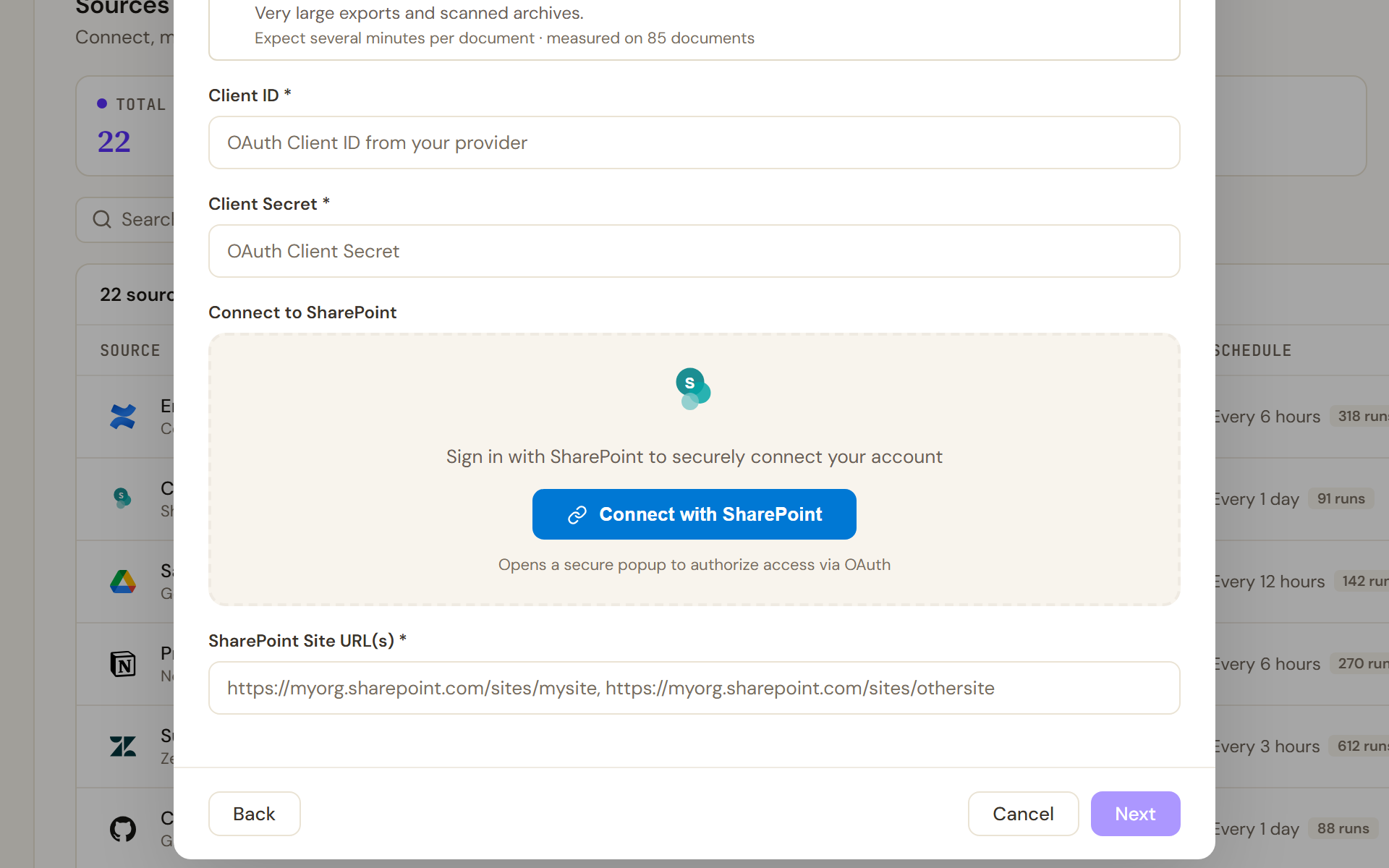
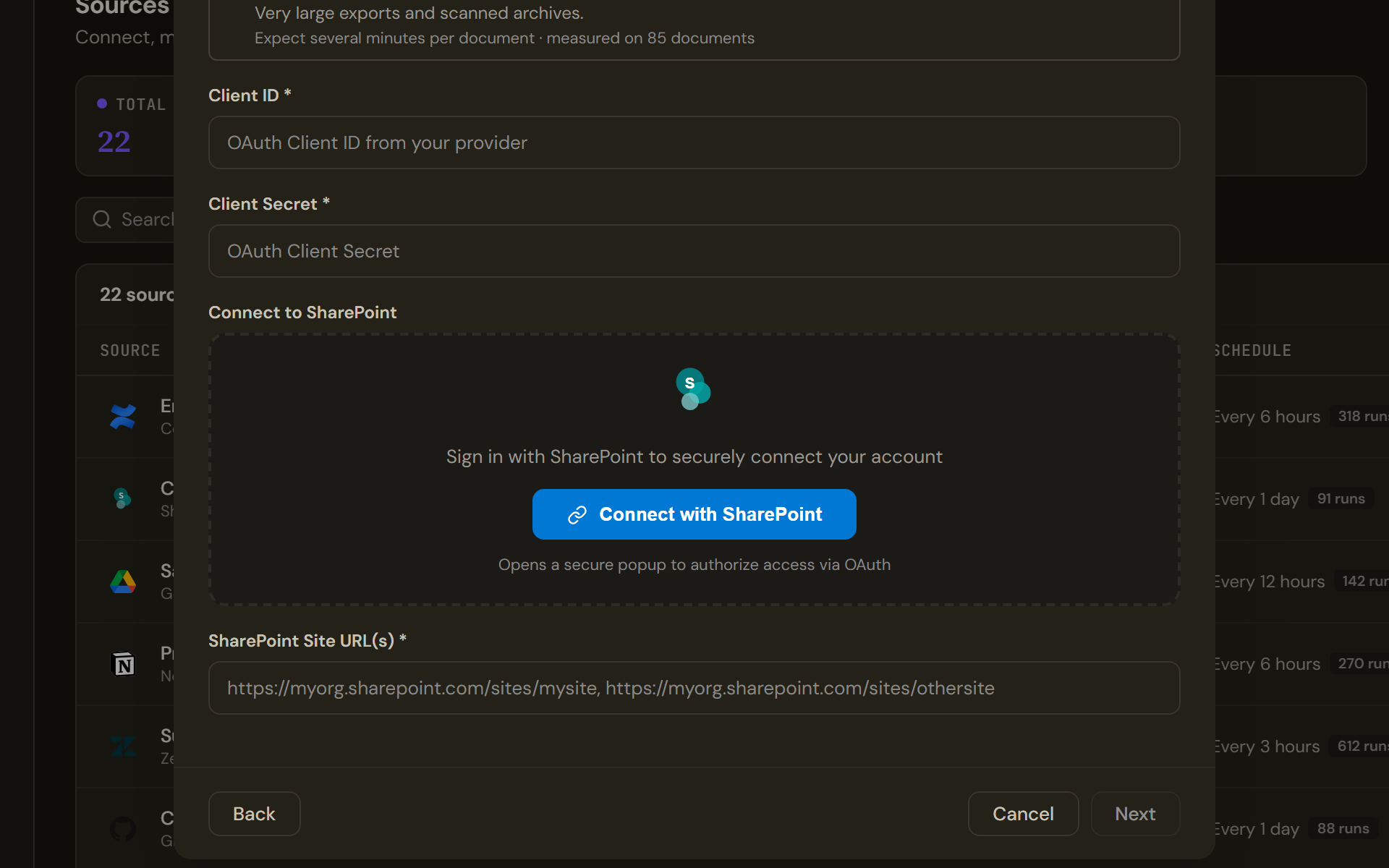
Configure for SharePoint: sign in with Connect with SharePoint, then name the sites to index in SharePoint Site URL(s), separated by commas. Next stays disabled until the source is named, connected and has at least one site. If your administrator has stored a SharePoint OAuth app, the Connect to SharePoint box reads Click below to sign in with SharePoint - credentials are pre-configured by your admin and you go straight to the button. Otherwise the step asks for a Client ID and a Client Secret first, and the box reads Sign in with SharePoint to securely connect your account. Connect with SharePoint opens a secure pop-up where you sign in to Microsoft and grant access; the button reads Connecting… while the wizard waits. On success the box changes to Connected to SharePoint with OAuth authorization successful, a notice confirms it, and Disconnect lets you start again. The wizard never asks for a tenant ID.
- Name the sites
SharePoint Site URL(s) sits beneath the connect box and is required. Enter the full address of each site to index, separated by commas. Next stays disabled until the source is named, connected, and has at least one site address. A connector may add settings of its own to this step.
- Schedule, access and review
Select Next. Set the Sync Schedule and the Knowledge plane, read the Permission Sync note, and choose the Access. Select Review. The summary lists Source, Name, Authentication as OAuth (connected), Schedule, Graph Extraction, Access, SharePoint Scope with the number of sites and their addresses, and ACL Sync as Enabled (source permissions captured each sync). Select Connect Source: it reads Creating... while the source is created, and the first sync starts straight away.
Verify
The new row appears on the Sources tab as Syncing, then Synced with a document count when the first sync finishes. Open the source: its Documents tab lists the indexed items and the Runs tab shows the first run. Then ask two people with different SharePoint permissions to search the source from the Work Room: each should see only what they could open in SharePoint. See Control who can use a knowledge source.
Troubleshooting
- Client ID and Client Secret are required. You selected Connect with SharePoint without filling both fields. Fill them, or ask your administrator to store the app on the Credentials tab so the fields disappear.
- Popup blocked. Please allow popups for this site. Allow pop-ups for the Katonic site in your browser, then select Connect with SharePoint again.
- OAuth didn't complete - the popup may have been closed. Try again. The wizard waits about two minutes for the sign-in to finish. Keep the pop-up open until it closes by itself, then retry.
- OAuth connection failed. Please try again., or a reason from the provider: the sign-in could not start, or Microsoft rejected it. Check the Client ID and Client Secret, or ask your administrator to run Test on the stored credential.
- Next stays disabled. The source needs a Knowledge Name, a completed connection and at least one site address.
- Source created, but the first sync couldn't start - open it and click Reindex. The source exists but nothing is indexed yet. Open it and select Reindex.
- Someone cannot see a document that others can. Because access mirrors the source, they most likely cannot open the item in SharePoint either. Grant access in SharePoint; the next sync carries it over.